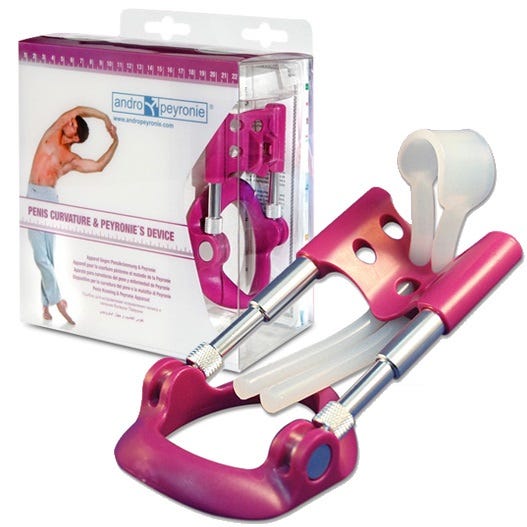
The Original and patented andropenis Penis Extender helping with Penis Enlargement For Over 20 Years
Penis extenders are one of the most used penis enlargement methods. The penis extender provides users with penis enlargement and male enhancement results. The AMDROPENIS Penis Extender has been FDA and CE.
Penis size is an important aspect of any man’s life and subsequently, ANDROPENIS Extender has developed the penis stretcher. The first penis enlargement product to provide real results, and increase penis size. This simple and easy to use penis enlarger can help improve sexual performance, stamina, as well as providing penis girth and length.*
Why purchase from andromedical.com? Real and fast penis enlargement, GUARANTEED! Advanced design, more comfort, and better penis enlargement results
A penis extender or penis enlargement devices are available through a wide variety of outlets; however, none offer the one of a kind 4-in-1 system or Quad support; designed to provide increased comfort which allows for prolonged use and subsequently better results. Its small, sleek, portable design allows you to use the penis stretcher in the comfort of your home, office, and even while you sleep.
andropenis penile traction devicePenile Traction Therapy For Treatment Of Peyronie's Illness: A Single-Center Pilot Research Study Penile Traction Therapy For Treatment Of Peyronie's Disease: A Single-Center Pilot StudyPublished Saturday 10 May 2018 Adapted Media Release UroToday.com - The pilot research study as well as recurring scientific experience indicates the crucial relevance of individual conformity if an enhanced result is to be gotten from use of the andropenis penile traction tool While of the research, other patients at the research study website were being treated with intralesional injections, an extra hostile treatment modality, with the expectation that remarkable results would certainly be accomplished. It was, actually, noted that a larger portion of the study people were accomplishing far better outcomes on grip alone. It was presumed that patient compliance was the figuring out factor. An absolute minimum of 2 hours utilize per day, four to six hours being excellent, are called for to produce favorable results over a 4 to 6 month period with traction treatment (andropenis). This is challenging for several people to achieve, as are numerous therapies calling for devoted self-monitored compliance. In making the research study protocol, it was determined to include once a week calls to each subject. These telephone calls were seemingly made to urge conformity, look at development, to provide early recognition of concerns and also to remind subjects of visit dates. The calls also satisfied of inspiring the subject and of producing a feeling of continuous rate of interest as well as support on the part of the researchers. This, it was felt, made a significant distinction in the level of subject compliance, and therefore the favorable end result achieved by all research topics. andropenis penis extender tool.Considering that conclusion of the study in November of 2017, Dr. Levine has actually continued to focus interest on the possibility of the andropenis Extender as component of combination therapies utilizing intralesional Verapamil as well as dental representatives. It is felt that, with proper patient compliance, the combination of penile grip therapy as well as intralesional medicines may supply both sped up as well as boosted results for Peyronie's clients. Data gathered by Dr. Levine currently is not sufficient to support certified statements about results, however present methods remain to check out the harmonies in between grip forces and the chemical results of Verapamil. Additionally, Levine as well as Newell, with other scientists, are creating studies on the capacity for the device to aid people gain back penile length adhering to loss of penile length prior to, and adhering to, radical prostatectomy, as well as prior to implantation of penile prosthetics. While the emphasis of the cited study was decrease of penile curvatures, it was likewise noted that individuals also accomplished gains in size.
This may indicate that the device can help patients restore all or part of penile length lost as a result of penile atrophy following prolonged erectile dysfunction (ED).
Written by Laurence A. Levine, MD, Mark Newell, PhD, Frederick L. Taylor ,MD, as part of Beyond the Abstract on UroToday.com.
Men who want surgery to increase the length of their penis should try non-invasive methods like penile traction device (andropenis) or extenders first, and in some cases, even try therapy to make them feel more confident about their bodies, said Italian urologists in a paper published in the April print issue of the British Journal of Urology International.
Marco Orderda and Paolo Gontero of the University of Turin carried out a research review and concluded that penile extender andropenis were more effective than other non-invasive methods like vacuum devices, exercises and botox injections.
They also noted that surgery was not necessarily the perfect solution that some might assume it to be.
Gontero, an Associate urology Professor, told the media:
"Based on current evidence, we suggest that penile extender (andropenis), not surgery, should be the first-line treatment for men seeking a penile lengthening procedure."
"Surgery is characterised by a risk of complications and unwanted outcomes and lack of consensus among the medical profession on the indications for surgery and the techniques used. That is why a non-invasive technique is preferable," said Gontero.
In some cases, psychological satisfaction is often just as important as physical changes, Orderda and Gontero noted.
Gontero said urologists are often approached by men worried about the size of their penis, even though in most cases, the penis is of normal size.
But there are some conditions such as Peyronie's disease and congenital abnormalities that can leave a man with a shorter than normal penis, as can surgical procedures like radical prostatectomy for men with prostate cancer. Lack of skin due to chronic inflammation or aggressive circumcision can also make the penis appear smaller.
And another condition is "hidden penis", often seen in obese older men whose belly fat and skin overlies the penis.
According to most of the studies that they reviewed, a penis was considered normal if its length when flaccid was more than 4 cm, and when erect, was more than 7.5 cm, but this also depended on height and BMI. The length was measured along the dorsal or upper side.
Gontero said that no studies have yet compared surgical and non-invasive methods of increasing penis length (andropenis).
"However our review suggests that penile extenders represent an effective and durable method of penile lengthening, capable of elongating the penis by an average of 1.8cm with minimal side effects. This compares favourably with surgery, which is much more invasive for the patient," he added.
Gontero and Oderda reviewed five evidence-based studies of penile surgery on a total of 121 men, and six evidence-based studies of non-surgical interventions covering a total of 109 men, 72 of whom used the penile extenders. All the studies were published between 2000 and 2009.
They found that surgical procedures resulted in average flaccid length increases of 1.3 to 2.5 cm, while studies of three types of penile extender (andropenis) resulted in average flaccid length increases of 0.5 to 2.3 cm.
Penile extender (andropenis) usually require the penis being in traction for several hours a day for several months, and the researchers wondered whether the gains were worth it.
A small number of the men who used penile extenders reported experiencing bruising, temporary discoloration, pain and itching.
One study that looked at the long term effects of repeated vacuum treatment in 37 men found no significant change in penis length after six months, although it reported a degree of psychological satisfaction for some men. One man reported experiencing numbness, and another man had a haematoma (blood under the tissue).
Another study they reviewed showed that botox may have a temporary effect in increasing flaccid length and decreasing penile retraction, while a further study suggested that using penoscrotal rings with an erectile dysfunction drug could help anxious men maintain an erection, but the reviewers could only find two case reports that measured how effective these devices were.
Ordeda and Gontero noted that despite the fact the idea appeals to a lot of men, and that it is widely discussed on the internet, probably because it is cheap and involves no invasive procedures, there is no evidence that exercises can help a man lengthen his penis.
Many men who feel their penis is too small are often surprised to discover that it is in the normal size range. This means there is a role for therapy in helping these patients, said the reviewers, who recommended they try cognitive behavioral therapy to improve their perception of their body image.
Written by: Catharine Paddock, PhD
Andropenis® is a patented high grade medical penis extender with PubMed® hospital studies. Results are Safe and Durable*. Comfortable tech with Andro-Comfort®. Money back guarantee.
One noninvasive technique to lengthen penises — penile traction devices — shows promise, according to a new review of research. But researchers say most men who seek longer penises don’t really know the long and short of their situation.
“Penile size is a matter of great interest among men who are affected by ‘short penis syndrome’ or just believe themselves to have a small penis, even though the dimensions of the organ fall within the normal range,” write urologists Marco Oderda and Paolo Gontero in the current issue of the British Journal of Urology International.
Oderda and Gontero, both from the University of Turin, Molinette Hospital, in Italy, concluded that for those men who have a normal-size penis yet persist in requesting treatment, penile extenders may be the way to go. Cognitive behavioral therapy may also be useful for building confidence in these men with psychological issues causing the mismatch between reality and what’s in their head, they write. [Related: Penis Myths Debunked]
What works
Several nonsurgical methods for lengthening the penis, such as penile traction gadgets, vacuum devices, penoscrotal rings and even “physical exercises,” have been popularized in the media.
To get a real picture of the science on such devices, the researchers did an extensive search for studies on the topic of “short penis” and associated treatments, ending up with just 10 studies that met their criteria.
Based on one study, vacuum devices got a failing mark, showing no significant penile elongation after six months of therapy, though the researchers of that study noted it provided psychological satisfaction for some men. Penile-lengthening exercises also had no science backing up their effectiveness.
The few well-conducted studies on penile extenders, which use mechanical traction to progressively elongate the penis, showed these devices can produce an “effective and durable lengthening of the penis,” the researchers write.
For instance, a small study published in 2002 in the International Journal of Impotence Research showed a penis stretcher called Andropenis could add 0.7 inches (1.8 centimeters) on average to the sex organ after four months of use for at least six hours a day. That extender device showed promise in another study with six months of use for at least four hours a day. And the Golden Erect extender was shown to increase penis length in participants of a study published in 2010 in the Journal of Sexual Medicine.
Who’s seeking treatment?
Many men who are concerned with their penis’s small stature suffer from “dysmorphophobia,” a condition where people see some imaginary flaw in physical appearance as real — in this case a false perception of penis inadequacy, the researchers say.
And apparently this male body-image problem is on the rise. According to LiveScience’s Bad Medicine columnist, Christopher Wanjek, “Many men long to have something longer, even though few have a penis that is too small to copulate or pleasure their partner. This anxiety over size is called penile dysmorphophobia, and it is on the rise worldwide as men turn to pornography and compare notes.”
Urologist Nicola Mondaini of the University of Turin in Italy agreed, telling LiveScience “this trend is increasing.”
That said, penile shortening is a real medical phenomenon and can be caused by so-called a radical prostatectomy for prostate cancer, Peyronie’s disease (an acquired penile deformity of the erect penis) and as a result of embryonic or developmental defects. In addition, a so-called “hidden penis,” caused by obesity, aging with an overlying fold of abdominal fat and skin, and a shortage of penile skin from circumcision, for instance, can also “shorten” the penis.
As for how prevalent penile dysmorphophobia is, in one study published in the International Journal of Impotence Research in 2002, 67 men with a median age of 27 came to the university hospital in Italy within a two-year period complaining of having a short penis. None of the patients fell into the category of a short penis; in other words, all were of normal size.
Sixty percent of the men said their feeling of inadequacy down there started in childhood when they noticed their friends were more endowed. Fifty-seven of these patients thought a normal penis length was somewhere between 3.9 and 6.7 inches. (10 and 17 cm). The others didn’t know what “normal length” was. These results suggest penis lengthening is not the answer, the researchers pointed out in that study.
One of the largest penis-size studies involved more than 3,000 men and found similar results — that most men seeking size enhancement were within the normal size range and overestimated the average penis size. That study was published in the International Journal of Impotence Research in 2002.
So what’s normal you ask? Anything greater than 1.6 inches (4 cm) flaccid and greater than 3 inches (7.5 cm) in a stretched or erect state. As for the average penis size, numbers vary depending on the study, but Mondaini says: 3.5 inches (9 cm) flaccid, 4.5 inches (12.5 cm) stretched and 5.9 inches (15 cm) erect.
Peyronie's disease (PD) is a persistent swelling of tunica albuginea of the corpora cavernosa that causes an inelastic plaque leading to penis deformation. Although its etiology is not completely known, there is basic consensus that PD is genetically sent and additional to penile injury. In the last few years, many researches showed the function played by oxidative stress and anxiety in PD pathogenesis, and other researches have actually defined effective use antioxidants in PD therapy. Oxidative stress is an essential part of this disease, influencing its progression. In the beginning of PD, the inflammatory infiltrate cells generate high amounts of complimentary radicals as well as proinflammatory and also profibrotic cytokines, with following activation of transcription aspect NF-κB. While conventional therapies commonly used in the early stages of PD consist of dental materials (Potaba, tamoxifen, colchicine, and also vitamin E), intralesional therapy (verapamil, interferon, steroids, and also extra lately collagenase clostridium histolyticum-Xiaflex), as well as regional physical treatment as well as penile extender (andropeyronie), the considerable outcomes acquired by arising treatments with the antioxidants cited in this write-up recommend these healing agents conflict at a number of levels with the disease's pathogenetic devices. Antioxidants therapy end results are intriguing for good professional method and additionally verify the fundamental role played by oxidative stress and anxiety in PD. Gianni Paulis,1,2 Gennaro Romano,3 Luca Paulis,4 as well as Davide Barletta5
1.1. Facilities of Microscopic as well as Functional Anatomy
The tunica albuginea of the corpora cavernosa is comprised of both collagen fibers (the majority) and flexible fibers. Whereas collagen fibers have greater resistance to traction as well as are inelastic, flexible fibers can be extended approximately 150% of their typical size [18] With no flexible fibers in the tunica albuginea, the penis would certainly not be able to expand in size and size during erection. In regular conditions and in the absence of disease, the elastic fibers along the penile shaft, within the tunica albuginea, appear as an internet interwoven with collagen fibers. Nonetheless, in the penile crura as well as distal part of the corpora cavernosa (apex), the tunica albuginea is just or virtually solely made up of collagen fibers [18, 19] Thus, any type of local change in flexible fiber web content can trigger penile deformation.
The function of this post is to clarify and also describe the considerable function of the oxidative tension in PD pathogenesis; the various other crucial goal of the write-up is to clarify the resulting function of anti-oxidants in PD therapy.
In 2012, a study examined PTX efficiency in 74 PD people utilizing a consolidated therapy that included dental PTX (400 mg/three times daily) associated with dental L-arginine (1 g/twice daily) as well as verapamil shots (12 in overall, every 2 weeks). Seventy-four PD patients were divided into 2 therapy teams: group I (39 patients), verapamil injections + dental therapy (L-arginine + PTX) + daily penile traction treatment PTT
Penile traction therapy PTT (andropeyronie) In recent years, penile traction therapy has gained considerable interest as a novel nonsurgical treatment option for men with PD and short penises [41]. PTT (andropeyronie) can increase the length of the penis and reduce penile deformity. Some studies have shown that penile curvature has decreased by 25°, sexual function has improved, and the risk of surgical indications has been greatly reduced [42]. PTT, as a method of treating PD, exhibits good tolerance, but the overall effect on PD is small when used alone. As part of the combined treatment of early PD, the PTT will play a more important role in the future.
Peyronie’s Disease is a connective tissue disorder characterized by the growth of fibrous tissue/plaque in the soft tissues of the penis, affecting middle-aged and elderly men.
The topic External Penile Traction due to Peyronie’s Disease you are seeking is a synonym, or alternative name, or is closely related to the medical condition Peyronie’s Disease.
Peyronie’s Disease
Quick Recap:
Peyronie's Disease is a connective tissue disorder identified by the growth of fibrous tissue/plaque in the soft cells of the penis, influencing middle-aged as well as elderly guys
It is an inflammatory process that happens in the tunica albuginea, which is a thick sheath of tissue covering the corpora cavernosa. The corpora cavernosa is a pair of sponge-like cells in the penis that aid in erection
Peyronie's Disease leads to discomfort as well as irregular bending of the penis, which makes it difficult for a man to have sex and maintain an erection. It normally affects the upper side of the penis, yet really rarely, it might influence the lower side or both lower as well as top sides too
The numerous possible sources of the condition includes injury or injury to the penis throughout sexual activity, sports injury as well as crashes, use of anti-hypertensive medications (calcium network blockers), and also making use of beta blocker drugs
Peyronie's Disease can lead to the formation of scar tissue that can be felt under the penis and bending of the penis. The feasible difficulties of the condition are impotence as well as a failure to perform sexual relations
A delay and also enjoy method may be complied with by the physician, when the flexing of the penis is not severe. Medications and surgical procedure might be required only when the problem is extreme and/or aggravates with time
Please find comprehensive details on Peyronie's Illness concerning meaning, distribution, risk factors, creates, indications & symptoms, diagnosis, problems, treatment, avoidance, diagnosis, as well as extra useful information RIGHT HERE :andropeyronie