Mostrando entradas con la etiqueta peyronie´s disease. Mostrar todas las entradas

jueves, 19 de julio de 2018

HOW IS PEYRONIE´S DISEASE TREATED?


International Society for Sexual Medicine “How is Peyronie’s disease treated?” ANDROPEYRONIE (MEDICAL PEYRONIE EXTENDER)


Traction therapy following surgery for Peyronie’s disease may increase actual and perceived penile length for some men, according to new research published in the Journal of Sexual Medicine.
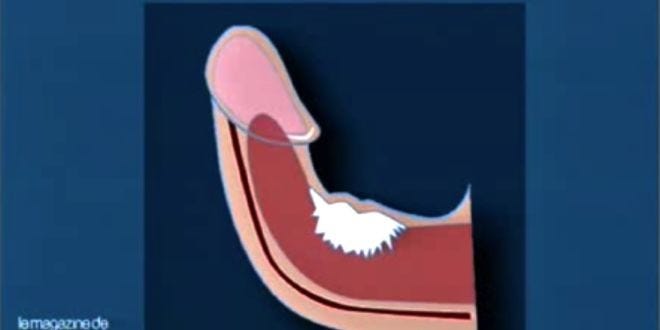
Peyronie’s disease, a wound-healing disorder, causes areas of hardened scar tissue called plaques to form on the penis. These plaques lead to decreased flexibility, resulting in a noticeable penile curvature during erection. Some men with Peyronie’s disease experience pain and are unable to have intercourse.
Surgery is one treatment option. Two types of surgeries pertain to this study. The first is called tunica albuginea plication (TAP) and involves stitching the area on the opposite side of the plaques to straighten the curvature. The other procedure is partial plaque excision and grafting (PEG), in which a surgeon makes an incision in the plaque and fills it with graft material.
One common complication of surgery for Peyronie’s disease is penile shortening, which can be a serious concern.
In this study, American researchers from Rush University Medical Center in Chicago worked with four groups of men. (A total of 134 men participated.) Two groups had TAP surgery, the other two had PEG procedures. For each type of surgery, one group had traction therapy and the other did not.

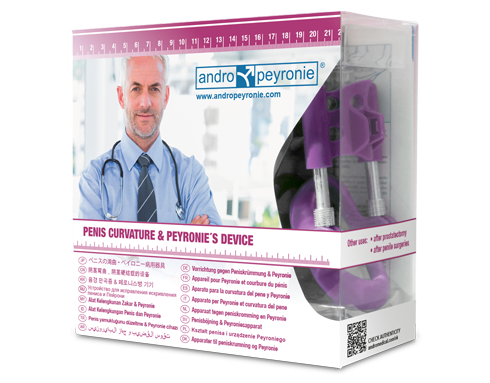
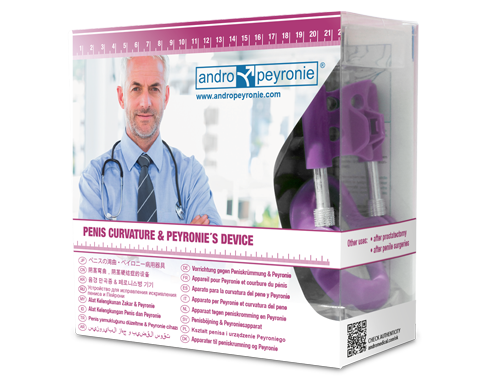
Traction therapy ( ANDROPEYRONIE ) involved wearing a traction device on the penis for a recommended 2–6 hours each day starting 3–4 weeks after surgery. From that point, patients were advised to use the device for three months. The goal of traction therapy (ANDROPEYRONIE) was to keep the penis straight as it healed and prevent length loss.
Stretched penile length measurements were taken before and after treatment. In addition, all men were mailed a questionnaire that asked about their perceptions of penile length change and their pre- and post-surgery satisfaction.
For the men who underwent TAP :
• The mean length change was 0.85 cm.
• 68% perceived erect length gain.
• 0% perceived erect length loss.
• 32% perceived no change in erect length.
For men who underwent TAP without traction therapy:
• The mean length change was -0.53 cm.
• 7% perceived erect length gain.
• 79% perceived erect length loss.
• 14% perceived no change in erect length.
For men who underwent PEG and traction therapy ( ANDROPEYRONIE ):
• The mean length change for was 1.48 cm.
• 47% perceived erect length gain.
• 0% perceived erect length loss.
• 53% perceived no change in erect length.
For men who underwent PEG without traction therapy:
• The mean length change was 0.24 cm.
• 14% perceived erect length gain.
• 57% perceived erect length loss.
• 29% perceived no change in erect length.
Overall, 69% of all participants were satisfied with their surgical outcome.
There were no complications or changes in penile sensation associated with traction therapy.
The researchers concluded that traction therapy can preserve some measured and perceived penile length after surgery for Peyronie’s disease. However, because of the psychological implications of penile length and outcome satisfaction, it is important for men to have realistic expectations before they have surgery.


Resources

International Society for Sexual Medicine
“How is Peyronie’s disease treated?”
Journal of Sexual Medicine
Rybak, James, MD, et al.
“A Retrospective Comparative Study of Traction Therapy vs. No Traction Following Tunica Albuginea Plication or Partial Excision and Grafting for Peyronie’s Disease: Measured Lengths and Patient Perceptions”
(Full-text. First published online: August 17, 2012)


lunes, 4 de junio de 2018

andro peyronie FDA Correction of curved penis: up to 60% correction

andro peyronie FDA Correction of curved penis: up to 60% correction


Conditions: Peyronies Disease

Traction Therapy for Peyronie’s Disease

Do you work with men who have Peyronie’s disease? If so, they might be considering non-surgical treatment options. One is traction therapy and a recent Journal of Sexual Medicine study has shown some encouraging results.
Peyronie’s Disease — Some Basics
First, however, let’s go over some basics about Peyronie’s disease. It’s thought to stem from a penile injury that does not heal properly. Such an injury could happen during sports or vigorous intercourse, but sometimes, a man doesn’t even know that he has injured his penis.
For men with Peyronie’s disease, areas of hardened scar tissue called plaques form below the skin’s surface. These plaques cause the penis to lose some of its flexibility and bend.
Peyronie’s disease occurs in two stages. In the acute phase (the first 6 to 18 months), the plaques form and the penis curves. Many men experience pain, erectile dysfunction (ED), and penile shortening. Intercourse may become difficult.
In the chronic stage, the disease becomes more stable. Usually, the curve doesn’t worsen, but men still can still have problems with ED and intercourse.
Significant emotional distress can also occur during each stage.
Treatment for Peyronie’s disease depends on its severity. For some men, the situation resolves on its own or the curve is not bothersome. For others, the curve is so severe that they cannot have intercourse at all. These men may consider surgical treatment once the disease reaches the chronic stage.
What is Traction Treatment?

Guy that undergo traction treatment for Peyronie's condition use a clinical gadget especially designed to carefully draw the penis in the contrary direction of the curve.

A current study by Spanish scientists located that this method had excellent results for guys in the severe stage of Peyronie's condition.

Fifty-five individuals (imply age 50) underwent traction treatment making use of the Andropeyronie gadget, a typically utilized brand. A control team of 41 clients (indicate age 48) had no treatment. All of the men had acute-state Peyronie's illness.

The males getting grip treatment were advised to wear the tool for at least six hrs a day, yet no more than nine hrs. Clients were likewise informed to get rid of the gadget for at least 30 minutes every 2 hrs to avoid glans ischemia. This group additionally had penile sonography to evaluate the condition of their plaques.

After six months of therapy, the guys in the grip therapy group saw a variety of improvements:

· Mean penile curvature at erection was lowered from 33 levels at baseline to 15 levels.

· Mean penile size increased from 12.4 centimeters at standard to 13.7 centimeters.

· The men reported less pain and also improved erectile feature and hardness.

· More men had the ability to permeate a companion.

· Sonographic plaques went away in 48% of the clients.

· The demand for surgery was minimized in 40% of the clients. Amongst the guys who did require surgical procedure, concerning one 3rd had the ability to have simpler treatments.

· These results were maintained at a 9-month follow-up point.

On the other hand, the males that got no treatment did not fare so well:

· After six months, their mean degree of curvature enhanced from 29 degrees at standard to 51 degrees after 6 months.

· Mean penile length decreased from 14.5 centimeters at standard to 12.1 centimeters.

· They reported extra pain as well as poorer erectile function and also hardness.

· Fewer men had the ability to pass through a companion.

· After 9 months, there were no considerable enhancements.

Compliance with therapy was an important aspect for the traction therapy team. The males put on the tool for a mean of 4.6 hours a day. Nonetheless, those who wore it for greater than 6 hours a day normally had much better outcomes.

Overall, the scientists wrapped up that penile traction treatment "seems an efficient therapy" for men in the intense stage of Peyronie's disease, as discomfort, curvature, and sex-related function enhanced in their study group.

Is penile grip therapy right for your patients? Maybe, especially if they are inspired to wear the tool for the recommended quantity of time. Nevertheless, only a urologist can answer this inquiry for certain. Clinicians are encouraged to refer their people with Peyronie's illness to the proper experts.

Print this short article or see it as a PDF data here: Traction Therapy for Peyronie's Disease

Resources

Andromedical Corp./ Andropeyronie.

" FAQ-- Method and also Instructions".

http://www.andropeyronie.com/faqs.

The Journal of Sexual Medicine.

Martínez-Salamanca, Juan I., MD, PhD, et al.

" Acute Phase Peyronie's Disease Management with Traction Device: A Nonrandomized Prospective Controlled Trial with Ultrasound Correlation".

( Full-text. Very first published online: November 22, 2013).

http://onlinelibrary.wiley.com/doi/10.1111/jsm.12400/full.

Sexual Medicine Society of North America.

" Peyronie's Disease".

http://www.sexhealthmatters.org/peyronies-disease.

Urology Care Foundation.

" Peyronie's Disease".

( Last upgraded: March 2013).

http://www.urologyhealth.org/urology/index.cfm?article=115.

https://www.andropeyronie.com/curved-penis-correction-peyronie/.

Bent Penis and also Peyronie.

It is very constant for the penis to be slightly rounded, and as people are not totally in proportion most males have a slight deviation away. This penile curvature is a natural phenomenon and also might not always signify any shortage or trouble.

Nonetheless, if the penis has a much more substantial curvature or is greatly curved upwards or to either of the sides or even downwards, this can in some cases suggest greater problems or perhaps a problem known as Peyronie's illness. A bent or bent penis is not always a repercussion of this illness, though, as it can be a repercussion of previous injury or accident (normally throughout sex or sporting activity), or perhaps an abnormality existing since birth. On the various other hand, the Peyronie's disease does not always show it-self with a curvature.
Some of the cases of penis curvature which occur later in life heal or improve naturally over time. This should happen within a year or maximum two. When the abnormalities are not too severe and do not hinder sexual activities the penis enhancement treatment is not really necessary. Even though, many patients do not need treatment because of the performance reasons, they want to improve the aesthetic appearance of their penis. To achieve this, two principle methods are available: penis enlargers and corrective surgery, the former being less invasive but slower than the latter. At this point it is also important to underline though, that a curved penis can also prevent a normal penis growth .

Curve Correction Extenders


Probably the best ratio between price, aggressiveness and effectiveness of the treatment still remains in the field of approaching Peyronie’s disease and other curved penis problems with penis extender specially adapted for this kind of treatment. The only downside of it being, it takes time and therefore patience to reach a satisfactory result.
The device can be medically prescribed by the personal physician, urology specialist or the patient can buy it by his-own initiative.

How Penile Extenders Correct Curvatures?

The device works in the same way as a normal penis enlarger that is used to attain a bigger penis. It is applying traction to the penis in the longitudinal direction and thus forcing it to stretch and consequently to grow, but at the same time, it is applying grater force on the shorter side and so pressuring it to correct the curvature. The shorter side will thus be stretched harder to elongate it a bit more. While this might seem a painful or at least uncomfortable procedure, the penis accustoms it-self to the constant pressure quickly and the patient does not feel annoyance after a short adaptation period.

Extender Correction Results

Different reports and studies have shown that stretching devices can partially correct congenital or acquired curvatures like Peyronie’s up to 40%; though, this procedure requires patience and discipline, as the device has to be used for several months. Absence of side effects makes them a good alternative to surgery. In some cases of less severe curvatures, penis extenders can also produce an additional penis enhancement.


viernes, 1 de junio de 2018

peyronie´s disease andropeyronie


The original
ANDROPENIS (20 years) is the only FDA registered  and patented penis
extender device sold in the US https://www.andromedical.com/andropenis/medical-penis-extender/
#penisextender #enlargepenis #bigpenis #penisenlargement, peyronie, andropenis
Be careful dont buy fakes¡


Controversies in Sexual Medicine: Is There a Place for Conservative Treatment in Peyronie’s Disease?

ABSTRACT


peyronie´s disease


andropeyronie